
CULTURAL INTELLIGENCE
The Skill We Need in a World of People from Diverse Backgrounds and Contexts
We often talk about intelligence as if it is one thing. IQ helps us think and solve problems. Emotional intelligence helps us understand emotions and relationships. But what happens when the difficulty is not the problem itself, but the fact that two people understand the same situation differently because of their cultural backgrounds?
This is where Cultural Intelligence, or CQ, becomes important.
CQ is an individual’s ability to function and manage effectively in culturally diverse settings. It helps us navigate differences in values, norms, communication styles, expectations and behaviour.
The important thing is that CQ is not simply cultural knowledge.
Knowing that another culture has different customs can be useful. But a list of facts does not automatically tell us what a person means in a particular situation. Cultural Intelligence requires us to think, observe, adapt and act.

Metacognitive
CQ

Cognitive
CQ

Motivational
CQ

Behavioural
CQ
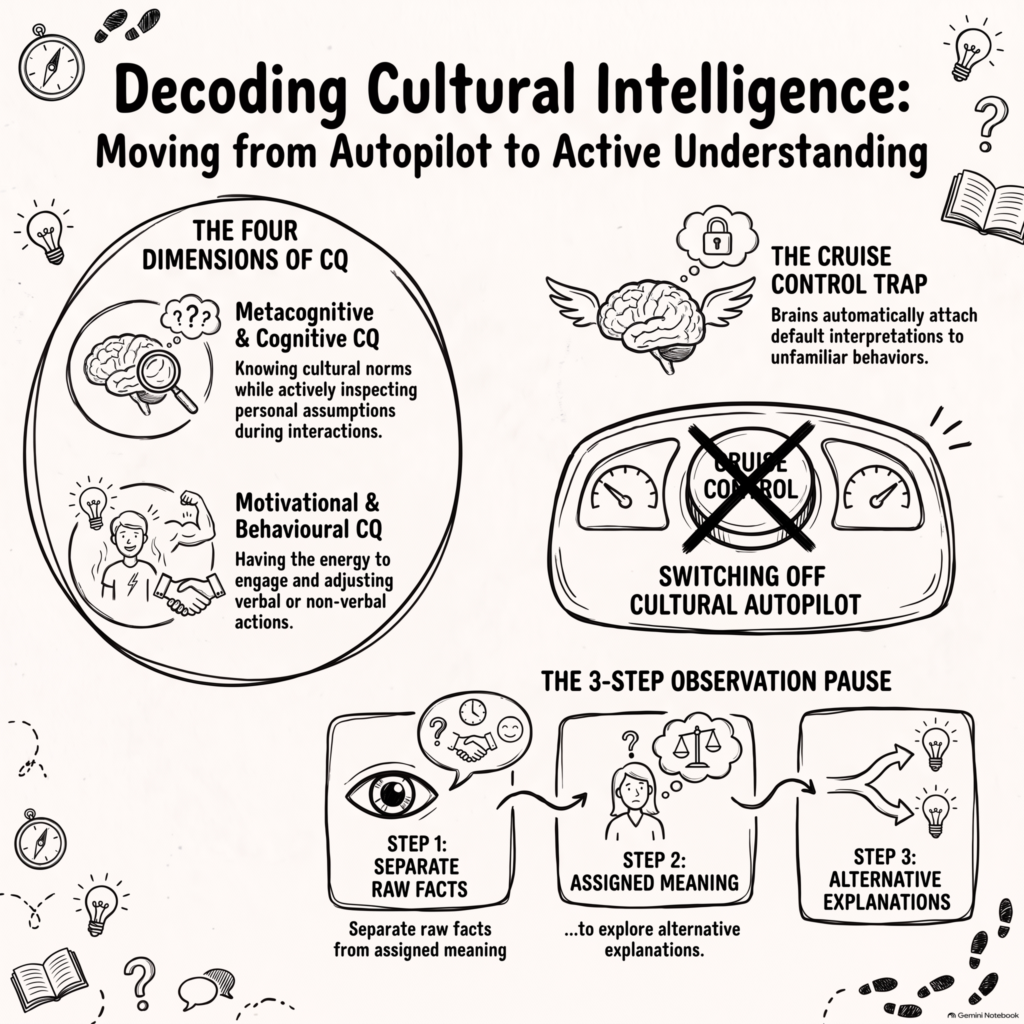
CQ IS COMMONLY DESCRIBED THROUGH FOUR DIMENSIONS.
- Metacognitive CQ is the ability to think about our own cultural thinking. It involves inspecting our assumptions, planning for culturally different situations and monitoring what we observe.
- Cognitive CQ is knowledge. It includes understanding norms, values, practices, conventions and systems such as family, religion, law, language and economics.
- Motivational CQ is the drive to engage. Crossing cultural boundaries can be tiring or uncomfortable, so we need energy, persistence and confidence to keep engaging.
- Behavioural CQ is adaptation in action. It includes adjusting verbal and non-verbal behaviour such as tone, pace, volume, gestures, facial expressions and ways of making requests or giving feedback.
Think of these four dimensions as parts of the same process.
You may know that a colleague comes from a culture where hierarchy is important. That is cognitive knowledge. But if you automatically interpret their silence as agreement, you may still misunderstand the situation. Metacognitive CQ helps you question that interpretation. Motivational CQ gives you the willingness to find out. Behavioural CQ helps you adjust how you ask and respond.
This is why CQ matters in workplaces, classrooms, teams and creative environments.
Cultural difference is not always dramatic. It can appear in small things: who speaks first, how directly someone disagrees, whether people expect detailed instructions, how relationships are built, how comfortable people are with risk, or how feedback is given.
The point of CQ is not to memorise every possible difference.
It is to become better at recognising when your own assumptions may not be the only possible explanation.
That shift can be surprisingly powerful.
Instead of asking, “Why are they behaving like this?” we can ask, “What expectations might be shaping this behaviour?”
Instead of “They are not interested,” we can ask, “What evidence do I actually have?”
Instead of “This is the right way,” we can ask, “Right according to which set of expectations?”
CQ does not make cultural differences disappear. It gives us a better way to work with them.
And in a world where people increasingly work, learn, create and communicate across cultural boundaries, that ability is becoming less of a niche skill and more of a practical one.
The author writes comics on Indian Cultural and nudges the young readers to move their thought processes and mindsets towards cultural intelligence. His comics can be found here