
CULTURAL INTELLIGENCE
When ‘Being Yourself’ Is Not
Enough: The Art of Cultural
Adaptation
“Just be yourself.”
It is usually good advice.
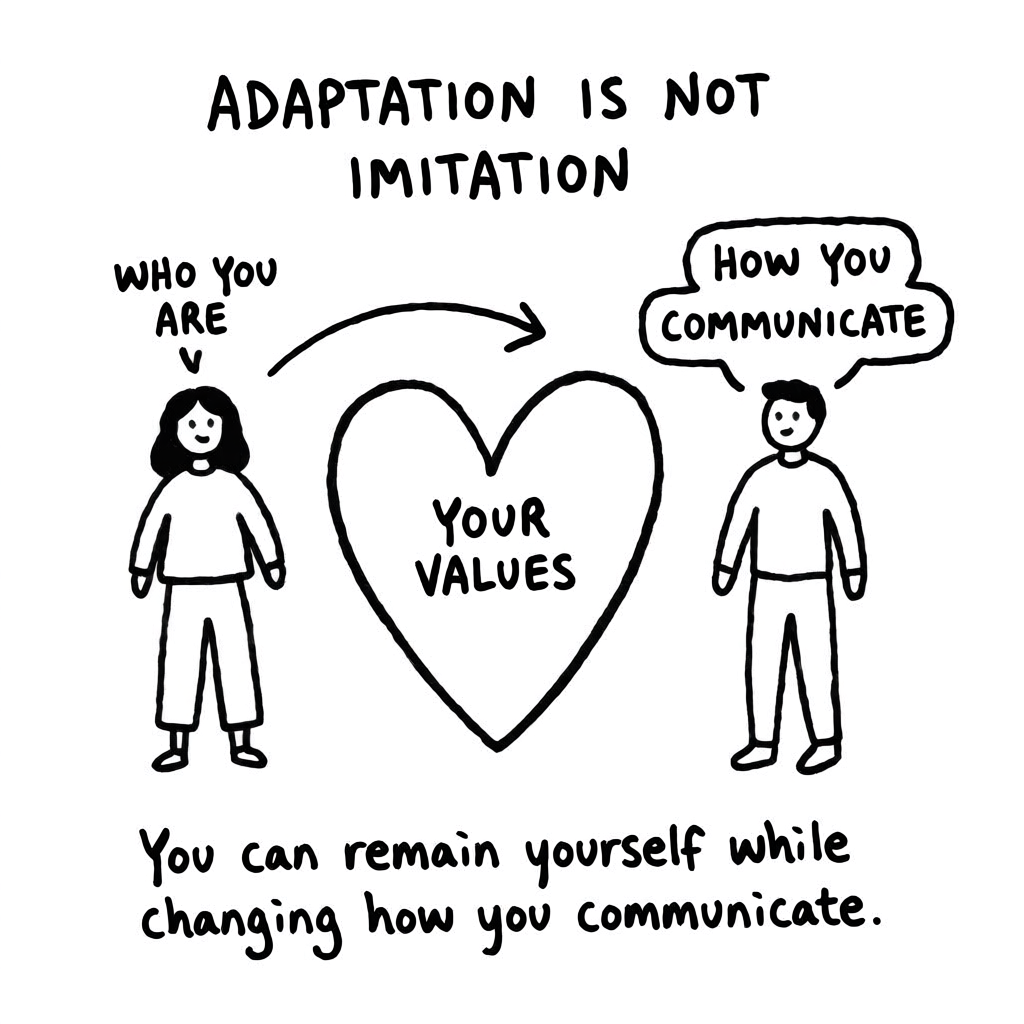
But when people work across cultures, there is a complication: the way we naturally express ourselves may not always communicate the meaning we intend.
This is where Behavioural CQ becomes important.
The same thing happens across cultures.
Behavioural CQ is the ability to adapt verbal and non-verbal behaviour to suit a culturally different situation. It can involve tone, volume, pace, gestures, facial expressions, physical proximity and the way we make requests, apologies or give feedback.
Consider direct and indirect communication.
One person may see a clear, direct request as efficient and respectful. Another may experience the same request as unnecessarily blunt. Neither person necessarily intends to create a problem.
The issue is that communication carries cultural expectations.
The same can happen with hierarchy. A manager may expect employees to challenge ideas openly. In another context, disagreement may be expressed more cautiously, especially when status or relationships are important.
Behavioural CQ asks us to notice these differences and adjust. This does not mean performing a fake personality. It means understanding that effective communication is partly about how the other person receives the behaviour, not only about what the speaker intended. Think about language. If you say, “I was only being honest,” that explains your intention. It does not automatically explain the impact.
Cultural Intelligence asks another question:
“What form will allow this message to work in this context?”
That might mean slowing down, changing the level of directness, giving more context, using a different form of address, or creating more space for the other person to respond.
This is why Behavioural CQ works together with the other dimensions of CQ.
Knowledge helps you recognise possible expectations.
- Metacognitive CQ helps you monitor whether your interpretation is accurate.
- Motivational CQ gives you the willingness to adapt.
- Behavioural CQ turns that understanding into action.
Importantly, adaptation is not a one-way responsibility. Effective interaction is not about one person endlessly changing while the other remains fixed. It is about creating enough flexibility for communication to work.
And there is a useful lesson here beyond international culture.
Every workplace has behavioural expectations. Designers, teachers, engineers, military personnel, artists, administrators and entrepreneurs may all develop different professional ways of speaking and behaving.
Sometimes we mistake familiarity for universality.
We assume that our preferred way of giving feedback, making decisions or showing confidence is simply “professional”.
It may only be one professional culture’s version of professionalism.
So perhaps the better version of “be yourself” is:
Be yourself but understand the context in which you are showing up.
You do not have to change who you are.
But you may have to change how you show up.
The author writes comics on Indian Cultural and nudges the young readers to move their thought processes and mindsets towards cultural intelligence. His comics can be found here