
CULTURAL INTELLIGENCE
Knowing About a Culture
Isn’t the Same as
Understanding It
Cultural knowledge is useful. But cultural knowledge can also
become a trap when we start treating it as a complete explanation
of people.
Cultural knowledge is useful.
But cultural knowledge can also become a trap when we start treating it as a complete explanation of people.
We might learn that one culture values hierarchy, another values direct communication, and another places greater emphasis on relationships. These patterns can help us prepare. But they do not tell us exactly what every individual will do.
Brooks Peterson’s work offers a useful way to think about cultural differences through five broad scales: equality versus hierarchy, direct versus indirect communication, individual versus group orientation, task versus relationship orientation, and risk versus caution.
These are not boxes into which people can be permanently placed. They are ways of noticing possible differences in expectations.
Consider a simple workplace example.
A manager from the United States works with a team in India and becomes frustrated because employees repeatedly ask for detailed instructions rather than immediately offering their own ideas. The manager may interpret this as a lack of initiative.
But another interpretation is possible.
If employees are operating within stronger expectations of hierarchy, taking unsolicited initiative may not feel like initiative at all. It may feel like stepping outside the expected role.
If employees are operating within stronger expectations of hierarchy, taking unsolicited initiative may not feel like initiative at all. It may feel like stepping outside the expected role.
The behaviour has not changed.
The meaning attached to the behaviour has.
This is why cultural knowledge should function more like a map than a script.
A map helps you know what you might encounter. It does not tell you exactly what will happen at every street corner.
THE DANGER BEGINS WHEN CULTURAL INFORMATION BECOMES A LIST OF RIGID RULES:
- They are indirect.
- They do not like risk.
- They are relationship-oriented.
- They respect hierarchy.
Statements like these may contain a pattern, but they can become stereotypes if we forget that individuals, organisations and situations vary.
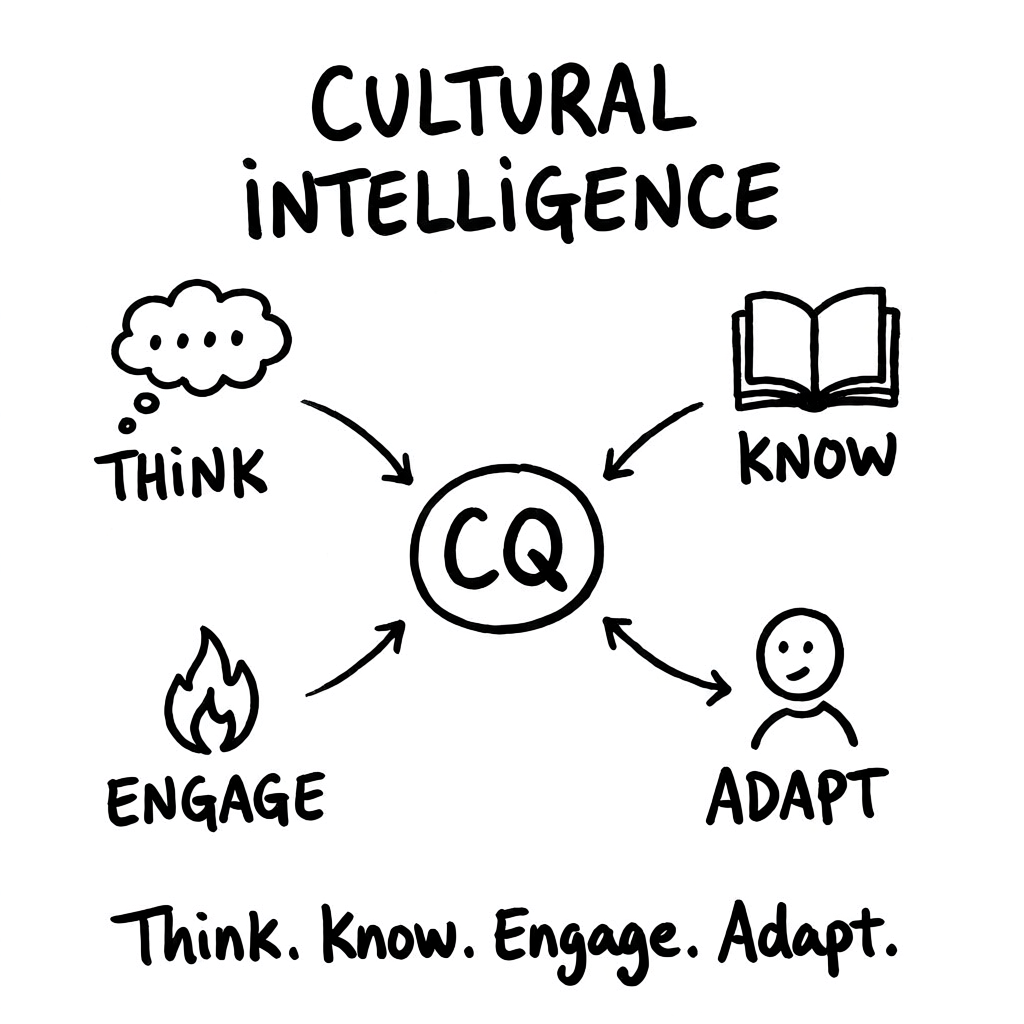
Cultural Intelligence therefore combines knowledge with metacognition. We use what we know, but we continue observing.
There is another important distinction here: culture is not only about nationality.
Professional cultures can differ. Organisational cultures can differ. Generational expectations can differ as well. Even two teams in the same city may develop very different ways of communicating and behaving.
So the useful question is not simply, “What is this culture like?”
It is, “What expectations might be operating in this situation?”
That shift is subtle but powerful.
Knowledge gives us possibilities.
Observation gives us evidence.
Metacognition reminds us that our first interpretation may still be incomplete.
Together, they help us move from cultural information toward Cultural Intelligence.
The aim is not to know everything about everyone.
It is to know enough to ask better questions and to remain willing to change our interpretation when the evidence changes.
The author writes comics on Indian Cultural and nudges the young readers to move their thought processes and mindsets towards cultural intelligence. His comics can be found here