
CULTURAL INTELLIGENCE
Why People Considered
Smart Struggle Across
Cultures
Understanding another culture intellectually does not
automatically mean we can work comfortably within it.
Sometimes the missing ingredient is motivation.
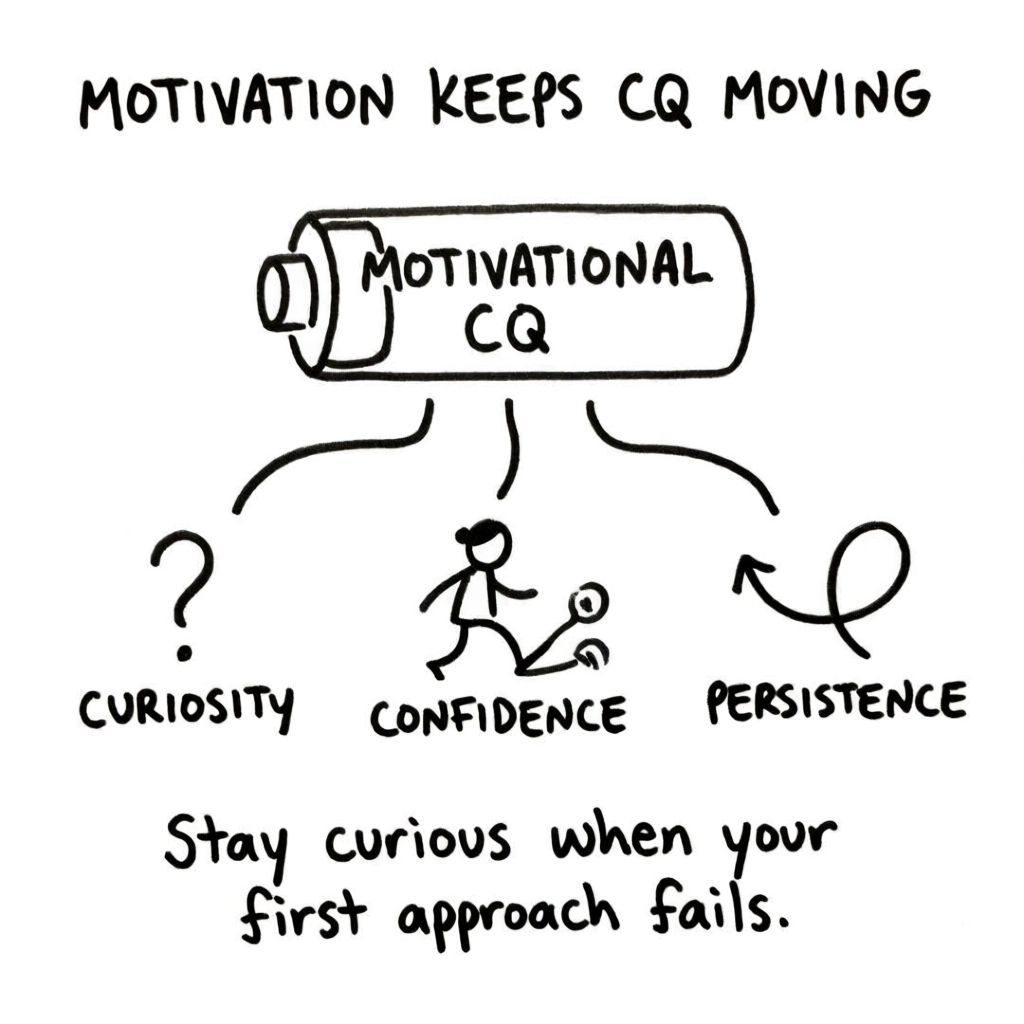
Motivational CQ is the drive and energy required to engage with culturally different situations. It includes intrinsic and extrinsic motivation, persistence and confidence in our ability to adapt.
This matters because cultural adaptation can be tiring.
Imagine entering a workplace where familiar social cues no longer work in the same way. You may have to think more carefully about how you communicate, how decisions are made, what counts as respectful disagreement, or how relationships are built.
Knowing what to do is one thing.
Having the energy to keep trying is another.
Motivational CQ helps explain why two people with similar cultural knowledge can behave very differently. One may remain curious and persistent when things become uncomfortable. Another may retreat to familiar habits.
Self-efficacy is particularly important. If we believe that we can learn to function in an unfamiliar environment, we are more likely to experiment, recover from mistakes and keep engaging.
If we believe that we simply “cannot work with these people”, every difficult interaction can become evidence supporting that belief.
This does not mean adaptation is always easy or that every cultural difference should simply be accepted. Cultural Intelligence is not about surrendering personal values. It is about developing the willingness and confidence to understand a different context and respond appropriately.
That distinction matters.
Adaptation is not the same as imitation.
You can remain yourself while changing how you communicate.
You can maintain your principles while recognising that another person may express respect differently.
You can disagree with an idea while still trying to understand the cultural expectations surrounding it.
Motivation also matters because cultural learning is rarely finished. Real situations are more complicated than cultural descriptions. People surprise us. Organisations develop their own habits. Context changes.
So CQ requires persistence.
A useful question when entering an unfamiliar cultural environment is:
“Am I willing to stay curious when my first approach does not work?”
That question gets to the heart of motivational CQ.
Cultural Intelligence is not only about having the right information in your head.
It is also about having enough curiosity, confidence and persistence to use that information, test your assumptions and keep learning.
Sometimes the biggest barrier between people is not that they cannot understand each other.
It is that they stop trying before understanding has a chance to happen.
The author writes comics on Indian Cultural and nudges the young readers to move their thought processes and mindsets towards cultural intelligence. His comics can be found here